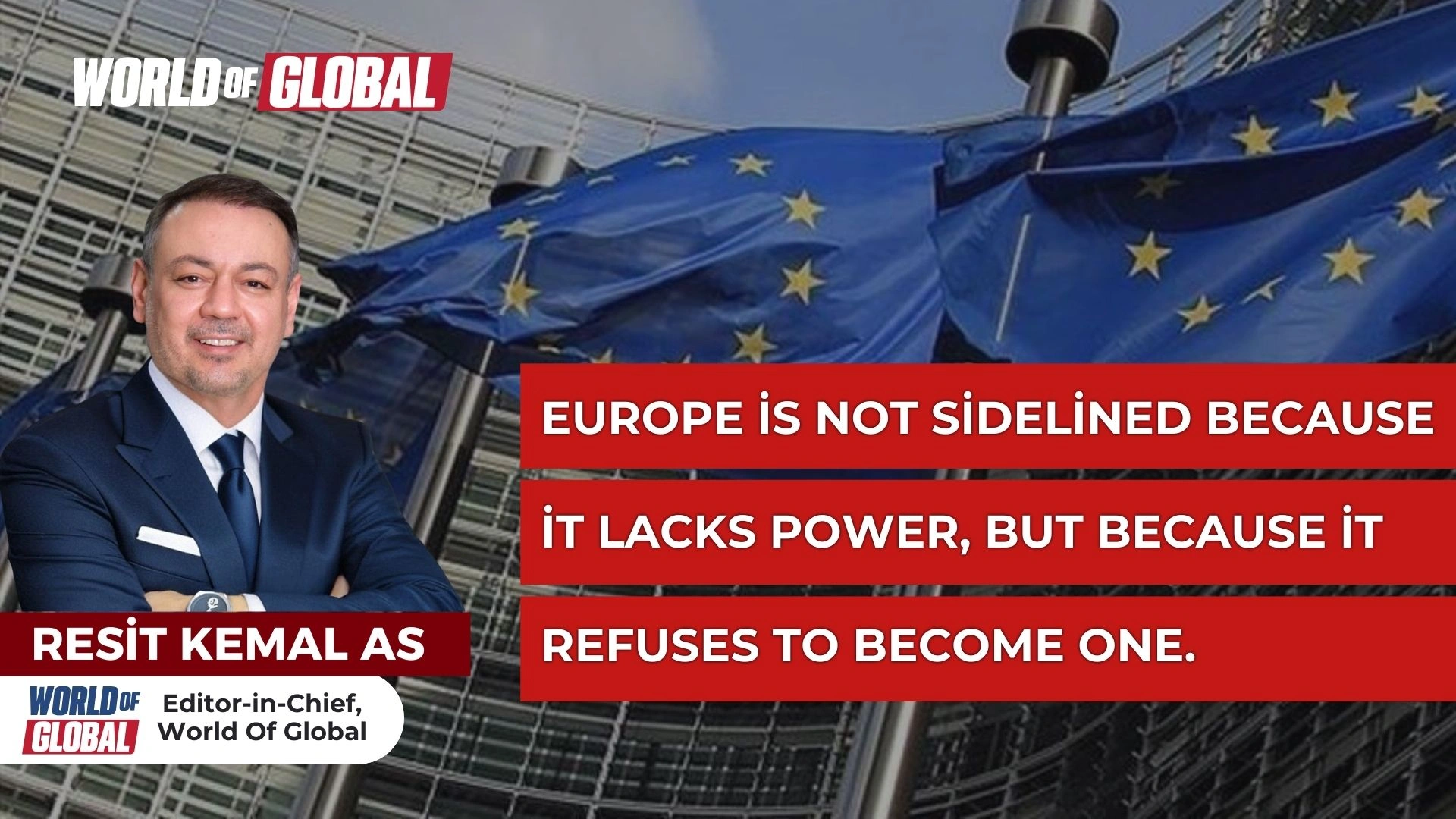
Resit Kemal As / Editor-in-Chief, World Of Global
Volodymyr Zelenskyy’s words carry more than a complaint; they are a harsh mirror held up to Europe. The statement “Europe is not a great power” is not merely an assessment of military or economic capacity, but the exposure of a deeper political and moral void. What Zelenskyy is essentially saying is this: Europe could be strong, but it chooses not to be.
The European Union was historically built upon the rhetoric of human rights, freedoms, and the rule of law. However, the war in Ukraine has clearly revealed how fragile this rhetoric is in practice. Across the continent, there are dozens of capitals, hundreds of summits, and thousands of pages of declarations—yet no clear, swift, or deterrent political will. From Zelenskyy’s perspective, Europe appears well-intentioned but indecisive; wealthy but timid; morally right yet politically hesitant.
Europe still does not behave like a strategic actor, but rather like a “coordination space” that reacts to crises. It is a structure that aligns itself when the United States leads, but loses its direction when Washington steps back. This is why Zelenskyy’s emphasis on Trump is significant. This is not about liking or disliking Trump; rather, Trump reminds Europe of a painful truth: when Washington’s priorities change, Europe is left on its own.
The phrase “Trump will not change” actually summarizes Zelenskyy’s sense of desperation. Because this is not only an observation about a single U.S. president, but about the general trajectory of American politics. The United States no longer wants to shoulder the cost of global security alone. Europe, meanwhile, is neither ready to share this burden nor willing to build its own independent defense architecture.
The result: a continent that has outsourced its security to others.
Zelenskyy’s sense of being cornered is no coincidence. Ukraine is fighting an existential war on Europe’s borders, yet in many European capitals this war is still perceived as a “distant crisis.” Energy prices, domestic political calculations, the rise of the far right—all of these factors erect barriers to sustained support for Ukraine. European public opinion is fatigued, and leaders are reluctant to take risks.
The tragedy here is this: even if Europe does not wish to be a global power, it cannot avoid making decisions with global consequences. What is at stake in Ukraine is not only territory, but Europe’s deterrence, credibility, and its politics of values. Zelenskyy’s harsh words are not just the grievance of an ally; they may also be a warning of an approaching rupture.
Perhaps the real question is this: does Europe truly want to “defend freedom,” or was this discourse merely a luxury of comfortable times? When crises deepen and real costs must be paid, do these values still hold?
Zelenskyy is not asking Europe for miracles. He is asking for clarity, speed, and determination. Europe, however, continues to hide behind compromise, postponement, and a wait-and-see policy. This is precisely the price of being beautiful but fragmented: no one truly listens to you.
Europe is not sidelined because it lacks power—but because it refuses to become one.