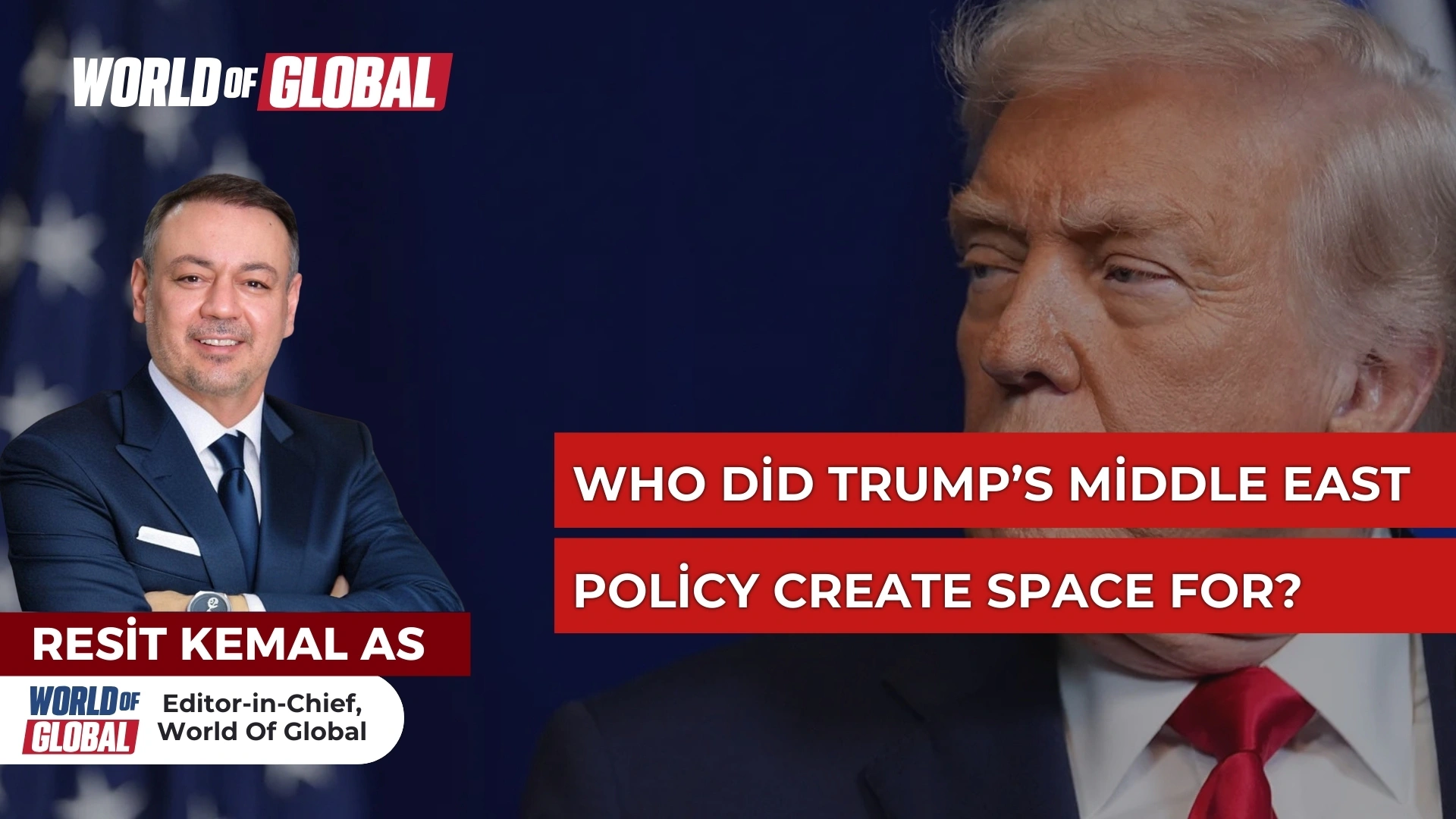
Resit Kemal As / Editor-in-Chief, World Of Global
Foreign policy is sometimes understood not by what is said, but by who gains room to maneuver from the actions taken. One must look not at the map, but at the timeline. At the sequence of moves, at which actors were relieved and empowered by them. Trump’s Middle East policy should be read in exactly this way. When examined carefully, the picture becomes clear: the common denominator of these moves was opening space for Israel.
What happened in the Middle East during the Trump era was not a chain of disconnected decisions. On the contrary, they were complementary moves following a clear strategic line. Recognizing Jerusalem as Israel’s capital, the decision on the Golan Heights, and reducing the Palestinian issue from a matter of international law to one of “power balances” — none of these were coincidences.
The Trump administration did not offer the Middle East a vision of peace; it offered a realignment plan. Israel stood at the center of this plan. Surrounding it were fragmented Arab states, absorbed in their internal problems and distant from one another. The document referred to as the “Deal of the Century” was not written for Palestine, but rather as a security document for Israel.
The appearance of the United States “reducing” its military presence in the region was also part of this picture. Talk of withdrawal from Syria and shifting responsibility to local actors in Iraq did not mean that Washington was leaving a vacuum. That vacuum was deliberately designed as a space in which Israel could operate more freely. As Washington stepped back, Tel Aviv stepped forward.
Iran policy must also be read within this framework. Trump’s withdrawal from the nuclear deal, the maximum pressure strategy, and the escalation of regional tensions effectively turned Israel’s long-voiced security concerns into official U.S. policy. As Iran came under greater pressure, Israel’s military and diplomatic room for maneuver expanded.
The Abraham Accords were the showcase of this strategy. Israel’s normalization with the Arab world was made possible without resolving the Palestinian issue. For the first time, Israel gained regional legitimacy without confronting the occupation question. This was a historic gain for Tel Aviv, and the formalization of isolation for Palestine.
Trump’s Middle East moves also sent a clear message: the United States was no longer a “balancer,” but an open party to the conflict. The role of referee was abandoned. A period began in which the rules were rewritten in favor of the strong. In this equation, Israel was not merely an ally — it was placed at the center of policy.
Looking back today, one thing is clear: the Trump era was a period in which Israel became militarily, diplomatically, and psychologically more comfortable. The reduction of criticism, the erasure of red lines, and the minimization of international pressure were natural outcomes of this process.
In the Middle East, no move is made in a vacuum. When a step is taken, someone always benefits. When Trump’s moves are read carefully, it is obvious who benefited most: Israel. Those who lost were once again unresolved issues, postponed justice, and abandoned peoples.
For this reason, Trump’s Middle East policy will go down in history not as a “period of surprises,” but as a period in which intentions were openly revealed.
Note: The Middle East will continue to pay the price for this clarity for a long time to come.