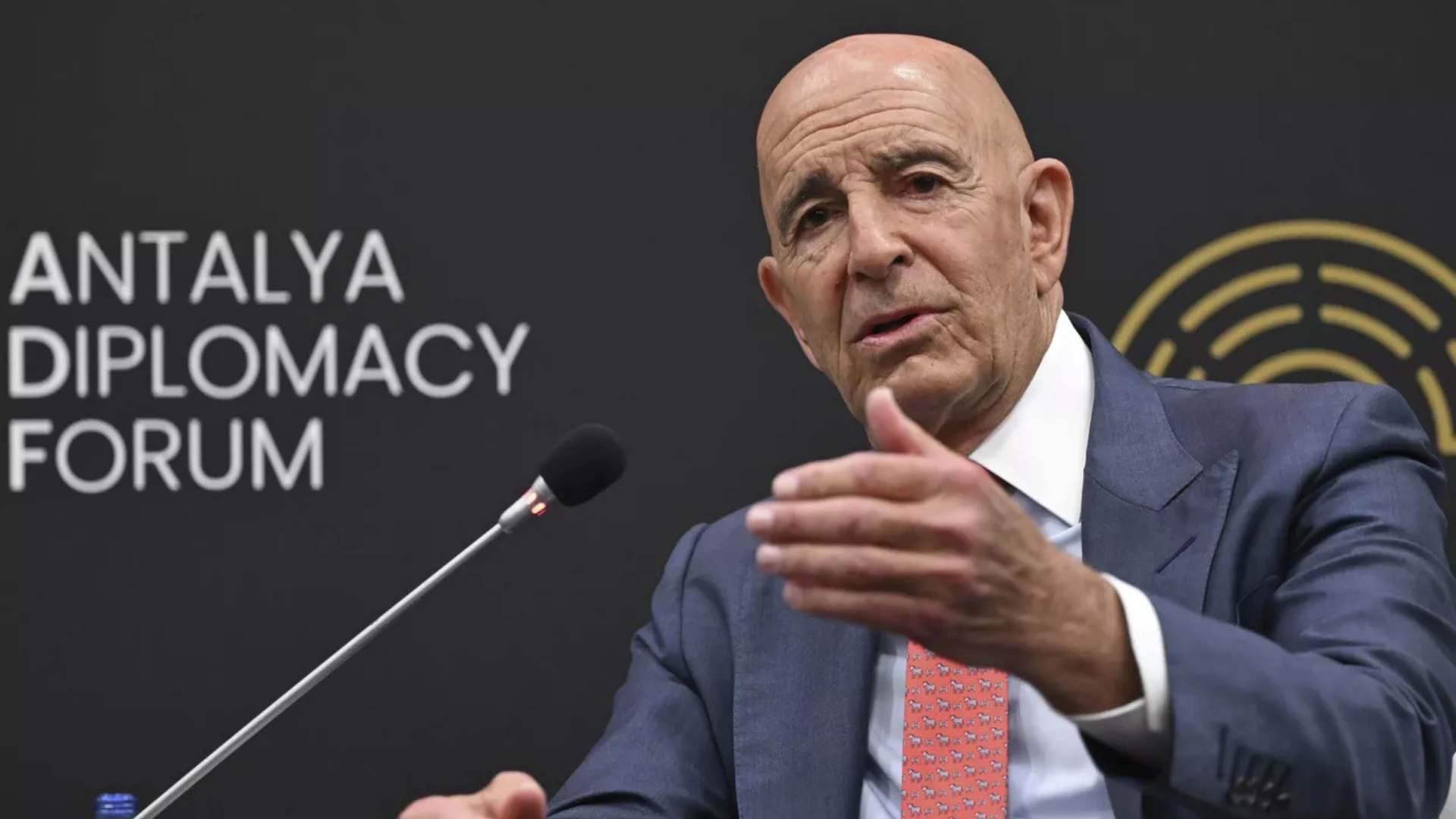
Tom Barrack, the U.S. Ambassador to Ankara and Special Envoy for Syria, said, “Netanyahu clearly stated that everything changed after October 7. He does not care about borders, he does not care about lines, he does not care about the 1967 border, the 1974 border, or the December 8 line.”
Ambassador Barrack made the remarks during a session at the 2026 Antalya Diplomacy Forum (ADF), moderated by TRT World senior anchor Andrea Sanke.
Barrack argued that Israel views the Druze in southern Syria as its own kin and claimed that following the events in Suwayda, Israelis crossed the border to “protect the Druze.” He continued:
“Netanyahu clearly said that everything changed after October 7. He does not care about borders, he does not care about lines, he does not care about the 1967 border, the 1974 border, or the December 8 line. Syria acted wisely by staying out of this conflict. That is why violations continue constantly. Every time Israel sees a convoy, it crosses these lines because there is still no trust between the two sides.”
Syria: ‘Not a single bullet has been fired at Israel’
Barrack stated that Syria has “repeatedly expressed its readiness for talks” and commented that it acted “very wisely by not taking a hostile stance toward Israel,” adding that normalization with Syria could come before Lebanon.
He emphasized that Syria—once troubled by internal conflicts involving Kurds and Druze, closely aligned with Iran, and long at odds with the international community—has now become one of the more stable places in the region.
Responding to a question about the absence of any agreement despite Syria refraining from military action against Israel, Barrack said:
“Since December 8, under President Sharaa’s administration, Syria has not fired a single bullet at Israel. On the contrary, President Sharaa has repeatedly stated that they do not want problems with Israel, are not seeking hostility, and are open to a non-aggression and normalization agreement.”
“Türkiye is among the strongest economies in the region”
Barrack said that attempts to eliminate enemies through military means do not produce lasting solutions and instead fuel cycles of hatred that persist for generations.
He noted that Israel’s approach since 1948 does not align with broader regional trends and that wars have not delivered sustainable outcomes.
Pointing to Lebanon as an example, Barrack said that the 1949 armistice agreement, the 15-year civil war, and the Taif Agreement failed to bring lasting stability.
He argued that Israeli attacks strengthen Hezbollah’s justification for existence and that militia groups backed by sovereign states like Iran cannot be eliminated solely through military means.
Barrack emphasized that Türkiye is not only NATO’s second-largest military power but also one of the most significant and influential actors in the region due to its population, resources, and military capacity.
Barrack: The path to a solution lies in prosperity
Barrack described President Recep Tayyip Erdoğan as an “effective leader” and said Israeli Prime Minister Netanyahu acts in line with his country’s interests.
Highlighting the importance of power dynamics in the Middle East, Barrack stated that perceptions of weakness place countries at a disadvantage.
Referring to developments in Syria, he underlined that strong leadership plays a key role in regional transformation processes and noted that Türkiye is an important actor in this context.