
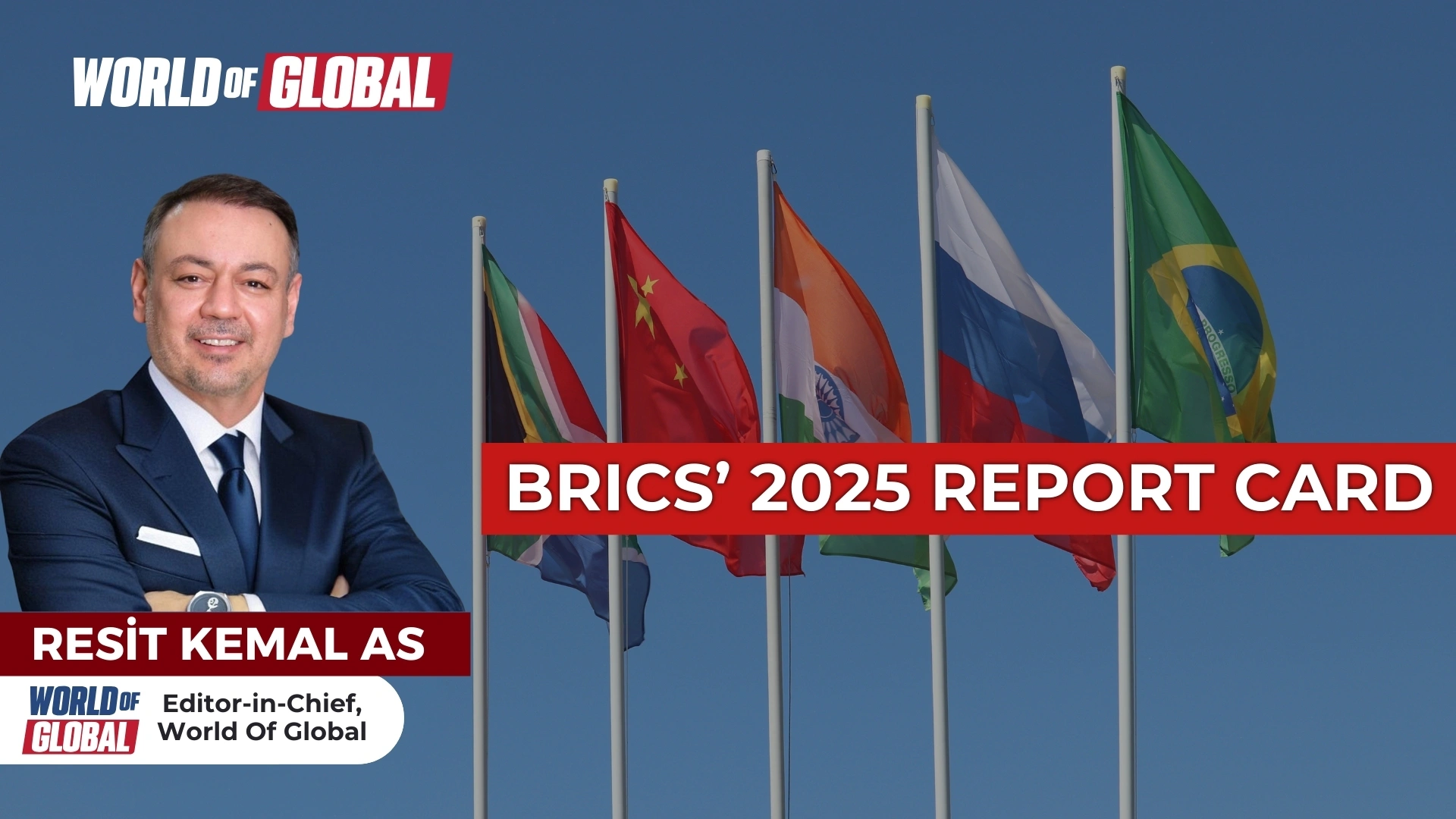
By Resit Kemal As / Editor-in-Chief, World Of Global
As the end of 2025 approaches, the BRICS world has received its report card and is looking itself in the mirror. The classroom is crowded, the desks are full, and ambitions are high. Yet the expressions on the teachers’ faces make one thing clear: the potential is high, but cohesion is low.
BRICS once again entered the “alternative world order” class with enthusiasm this year. The diagnosis that the Western-centered system is outdated, unjust, and has lost its representative power was a shared view across the classroom. On this point, almost everyone gave the same answer. The problem began with the next question: So what are we putting in its place?
That is where the class fell apart.
Political posture grade: Pass, but weak.
Throughout 2025, BRICS countries frequently invoked the rhetoric of sovereignty, multipolarity, and non-intervention. However, unity in rhetoric did not translate into unity in action. Everyone spoke on behalf of the “Global South,” yet most underlined their own national priorities in bold. There was a common language, but no common tone.
In the economics lesson, the picture was even more complex.
On one side stood massive markets, young populations, and production capacity; on the other, slowing growth, fragile currencies, and financial systems distant from one another. BRICS did not like talking about the dollar this year, but it also did not dare to abandon it entirely. Alternative payment systems were submitted as homework, but they have not yet been tested in an exam.
China was the class’s diligent student, yet cautious about assuming a leadership role. It tried to steer without stepping too far into the spotlight.
India performed well in oral exams, successfully maintaining its balancing policy, but preferred to wait at critical moments of decision.
Russia came to class with its own agenda every time; it remained unclear whether it was on the same page as the class or writing in a separate notebook.
Brazil and the others tried to be the group’s conscience and softer voice, but amid the noise, their voices were at times drowned out.
In the geopolitics section, the most frequent remark on BRICS’ report card was “indecisive.” Faced with global crises, no bloc reflex emerged. Everyone took a position, but they did not line up on the same axis. This kept alive the question of whether BRICS is still merely a “platform” or a true “bloc.”
The Reality Inside, the Story Outside
On the societal and domestic political front, the picture was clearer: while BRICS countries sought to present an alternative to the world, they struggled to confront inequality and governance problems within their own borders. The gap between the story told to the outside world and the reality lived at home became even more visible in 2025.
As the year drew to a close, BRICS’ overall report card was summed up in a single sentence:
“Strong intent, weak coordination.”
In 2025, the BRICS world did not shake the system, but it unsettled it. It did not break the game, but it ensured that the rules were debated. Perhaps that was this year’s real achievement.
Still, one question remained on the table:
Is BRICS truly building a shared future,
or is it merely a temporary gathering of countries that share the same discomfort?
The answer will be sought in 2026.
As for 2025, it was recorded in the notebook as follows:
A crowded classroom — but not yet a shared lesson.