
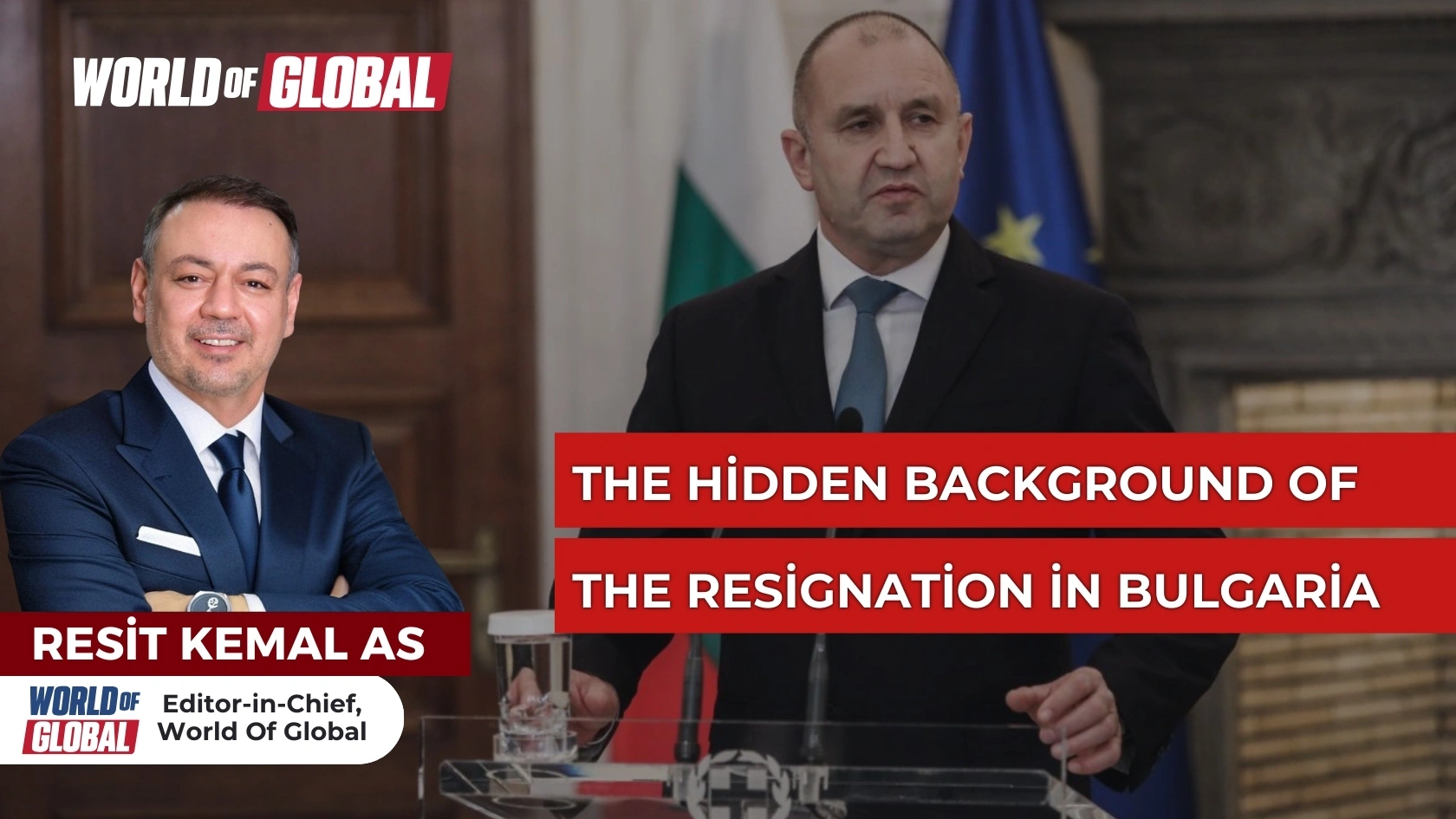
Resit Kemal As / Editor-in-Chief, World Of Global
The global agenda has never been this noisy. The war in Ukraine, the Gaza crisis, U.S. elections, Trump–NATO tensions, the China–Taiwan line… Headlines are big, voices are loud. Precisely for this reason, some developments unfold quietly—without cameras, yet with the potential to produce far deeper consequences in the long run. The political turbulence in Bulgaria is one of these “silent storms.”
When one looks at the official explanations, the picture seems familiar: political deadlock, corruption allegations, reform fatigue, coalition crises… The resignation is presented as a routine reflex of the system. But the real question is this: Is it truly that simple? Or is the resignation in Bulgaria a small yet critical piece of much larger geopolitical calculations?
Bulgaria may look small on the map, but its location ignites the interest of great powers. A gateway to the Black Sea, the lock of the Balkans, a transit zone caught between the EU and Russia… In terms of energy corridors, military logistics, intelligence flows, and struggles for political influence, it is an exceptionally strategic country. In such a geography, no political crisis can be explained solely by domestic dynamics.
In recent years, Bulgarian politics has been trapped in a state of constant instability. Governments are short-lived, coalitions fragile, street politics exhausted. This environment creates fertile ground for external pressure. EU reform demands, NATO expectations, pressures to distance the country from Russia—all push from different directions. Leaders, in the end, find themselves squeezed between their own publics and external actors.
Behind the resignation lie possibilities that are spoken of quietly but rarely voiced aloud. Tensions in energy policy, especially dependence on Russian gas. The growing pressure to “choose a side” following the war in Ukraine. Power purges carried out under the banner of anti-corruption. And, of course, the West’s search for more “compatible” administrations in the Balkans. None of these factors alone may be decisive; but together they create an atmosphere that renders resignation almost inevitable.
What is striking here is the indifference of the international public to this development. The crisis in Bulgaria does not erupt in an explosion; it advances slowly and quietly. There are no tanks in the streets, no harsh statements. Yet it is precisely this silence that reinforces the impression that what is happening is “managed” or “controlled”—as if a button has been pressed and the process left to run its course.
This is where the real danger lies. Silent resignations often produce more lasting consequences than loud revolutions. A leader steps down, a government falls—but the structure that replaces it usually operates with a narrower room for maneuver. The discourse of independence weakens, external dependence grows. The public, meanwhile, drifts further away from politics with the feeling that “nothing really changes anyway.”
In conclusion, the resignation in Bulgaria is not merely an internal affair of one country. It is a small but meaningful move on the global chessboard. At a time when the world is focused on major crises, it reminds us once again that the real game is often played at back tables.
The question to ask is not who resigned in Bulgaria, but which policies were abandoned, which balances were recalibrated, and who benefited from this silence. The answers are not found in headlines, but hidden between the lines.