
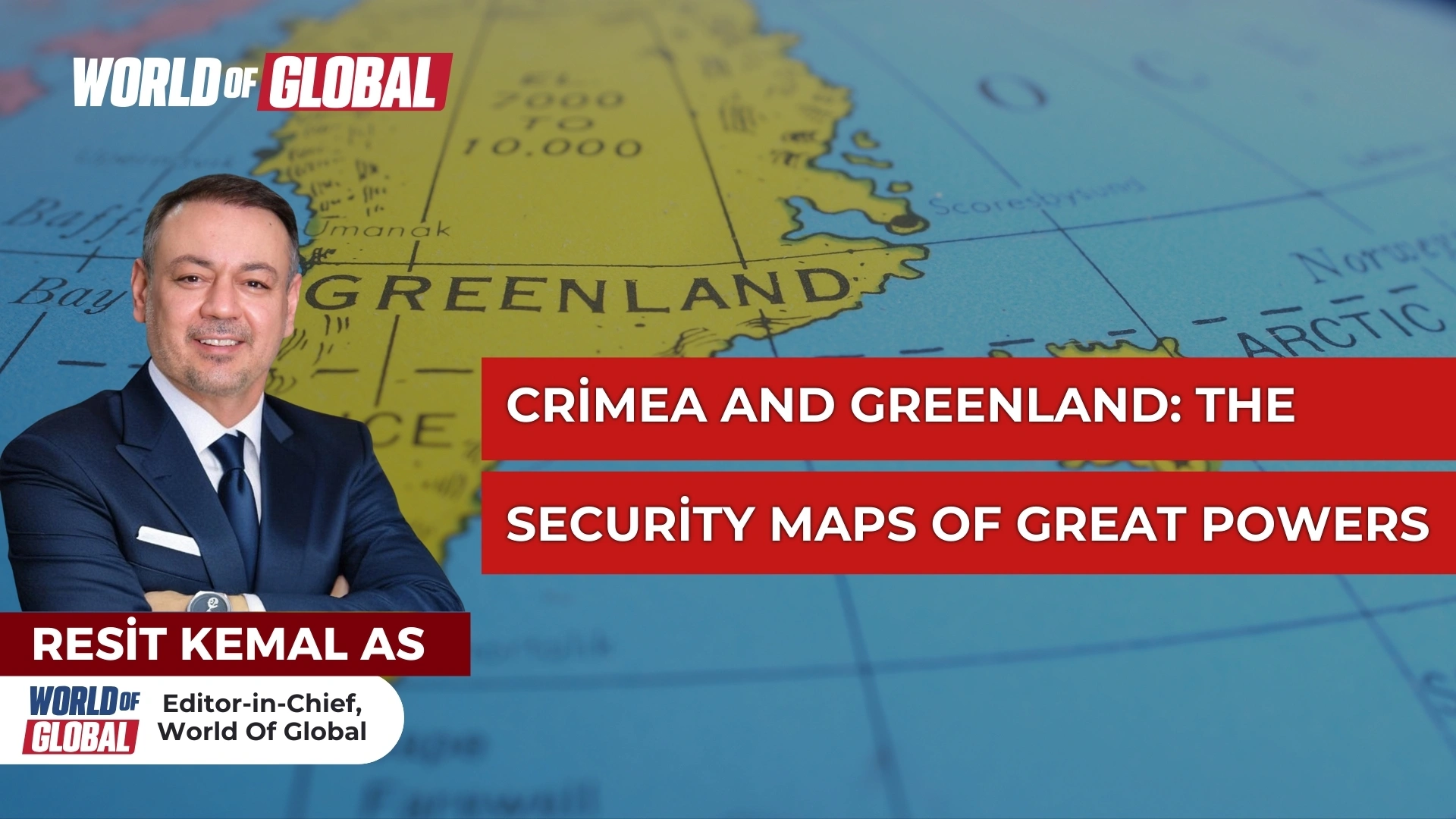
Resit Kemal As, Editor-in-Chief, World Of Global
In international politics, there are certain geographies that may appear small on the map but carry enormous weight in the strategic equation. Crimea and Greenland are among the most striking examples of this category. What Crimea represents for Russia, Greenland represents for the United States. This comparison is not an exaggeration; on the contrary, it is instructive for understanding the security reflexes of great powers.
Crimea is Russia’s gateway to the Black Sea. It is not merely a peninsula, but the backbone of Russia’s historical depth, naval power, and defense doctrine. Without Sevastopol, it is inconceivable for Russia to remain a permanent power in the Black Sea. For this reason, Moscow views Crimea not as a geopolitical choice, but as an existential necessity. What the West calls an “annexation” is perceived in Russian strategic thinking as the “consolidation of security.”
Greenland serves a similar function for the United States. As a key node in the North Atlantic and the Arctic, this vast island is not just allied territory for Washington, but a cornerstone of early-warning systems, missile defense lines, and the protection of North America from the north. Since the Cold War, U.S. sensitivity toward Greenland has remained unchanged. The idea of “buying” Greenland voiced during the Trump era was less a fantasy than a blunt expression of this strategic reality.
What is truly striking, however, is the U.S. refusal to acknowledge the similarity between its rhetoric on Greenland and Russia’s justifications regarding Crimea. While Washington emphasizes international law and sovereignty in the case of Crimea, it absolutizes security concerns when Greenland is at stake. This double standard is a clear indication that the global system operates not on moral principles, but on power.
Meanwhile, the United States is well aware that neither Russia nor China has a concrete plan to “seize” Greenland. Russia has no military or political agenda regarding Greenland; Moscow is focused on its own coastline and maritime routes in the Arctic. China, for its part, approaches Greenland not with military ambitions but with economic and scientific interests—mining, rare earth elements, and polar research. Nothing more.
So why does the United States emphasize Greenland so loudly?
Because the issue is less about the intentions of rivals and more about the alignment of allies. This is precisely where the divergence between the U.S. and the EU begins. The European Union views Greenland through Denmark as a matter of sovereignty and international law. The United States, however, seeks a firmer and more centralized control framework in the name of NATO’s northern flank security. This signals a quiet yet profound rift in transatlantic relations.
For the EU, Greenland is part of the European order. For the U.S., it is a military platform. There is an irreconcilable difference in tone between these two perspectives. Washington’s security-centric approach is perceived in Brussels as an attempt to bypass Europe altogether. This is why the Greenland issue constitutes a calm surface masking a diplomatically charged fault line.
The silence of Russia and China is not accidental, but deliberate. Moscow benefits from observing tensions within the West from a distance. Beijing, by remaining quiet, preserves its long-term economic presence without inflating threat perceptions. Both actors understand that they have more to gain from silence than from speaking.
Ultimately, Crimea and Greenland are two mirrors reflecting how great powers define security. Security is universal in rhetoric, but highly selective in practice. Every power views its own red lines as “legitimate” and those of others as “threats.” As long as this contradiction remains unresolved, crises will continue to be the rule rather than the exception in world politics.
Maps may not change; but the meanings imposed upon them are harbingers of new tensions. Crimea lies in the Black Sea, Greenland in the Arctic—but both ask the same question: Security for whom, and at what cost?