
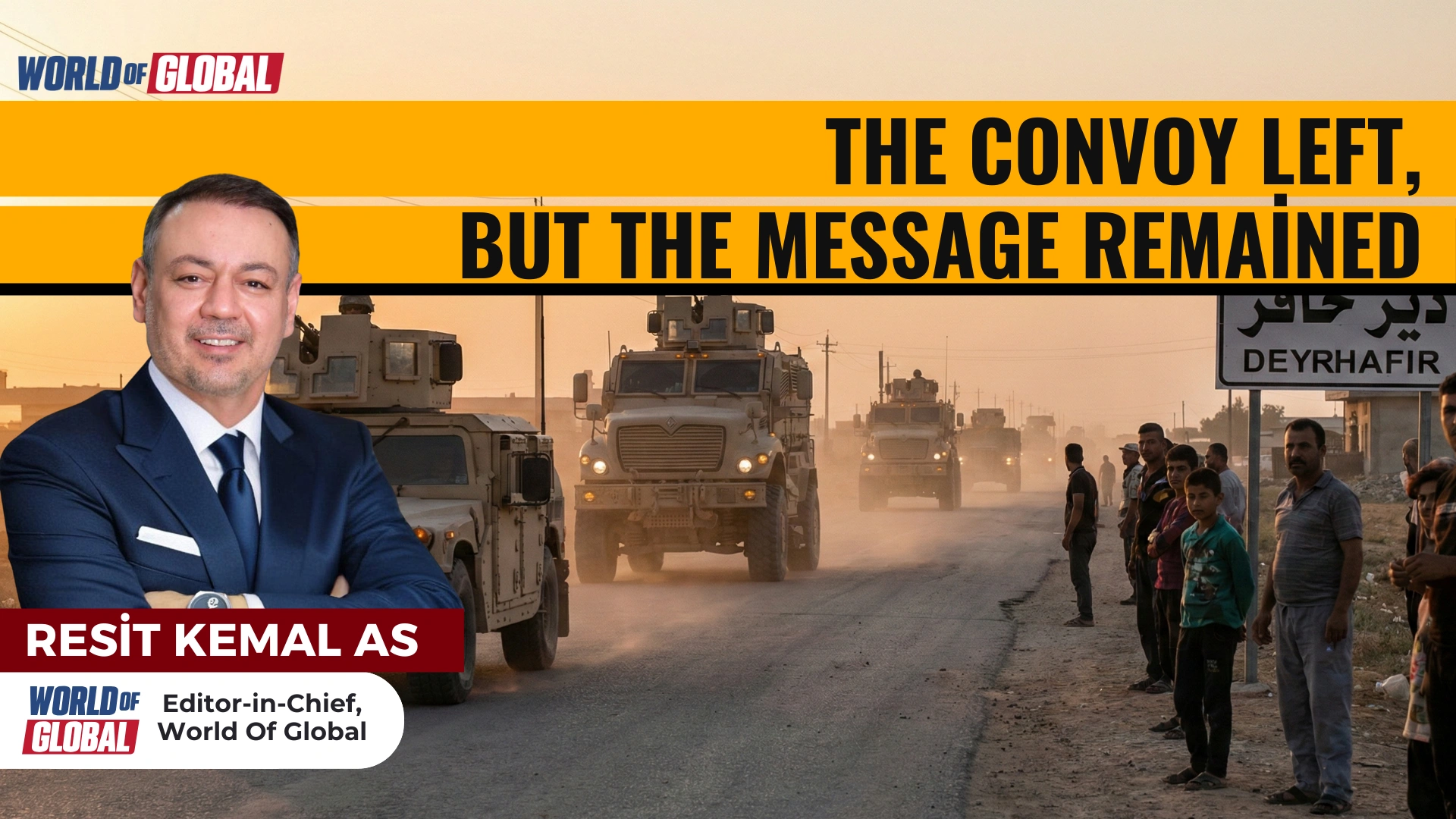
Resit Kemal As, Editor-in-Chief – World Of Global
There was no firefight in Deir Hafir. No exchange of gunfire, no breaking headlines of a new front opening in Syria. Yet what unfolded there was far from insignificant. The brief entry of a U.S. military convoy into Deir Hafir—followed by a rapid withdrawal and an almost immediate statement from the Syrian Democratic Forces (SDF) announcing their own pullback—was not a retreat in the conventional sense. It was a strategic probe, and one with serious implications for both the United States and Europe.
On the Syrian battlefield, the most consequential developments are often defined not by escalation, but by restraint. And restraint, in this case, signals friction.
Had everything gone according to plan, the convoy would not have turned back.
Movements of this nature—particularly in an area like Deir Hafir, where the Syrian regime, Russia, and Iran all have entrenched interests—are not improvised. The decision to withdraw points to one of three possibilities: unexpected resistance on the ground, a firm diplomatic warning, or a behind-the-scenes negotiation in which red lines were clearly communicated.
For Washington, this maneuver fits a familiar pattern: advance, observe, recalibrate. The United States often tests the boundaries of contested zones without committing to escalation, measuring reactions before deciding on the next step. This is not weakness; it is risk management. But risk management also implies limits—and Deir Hafir appears to be one of them.
The SDF’s subsequent announcement—“we are withdrawing”—should be read carefully. It is less a military statement than a political one. By framing the pullback as its own decision, the SDF seeks to avoid the perception of abandonment by its primary backer, the United States. This underscores a deeper reality that European and American audiences should not ignore: local partners in Syria remain structurally dependent on U.S. strategic choices, yet increasingly exposed when those choices encounter resistance.
Is the SDF truly withdrawing? Or merely repositioning?
In Syria, “withdrawal” is rarely geographic; it is tactical. Leaving one area often means reinforcing another. For policymakers in Washington and European capitals, this distinction matters. It means that apparent de-escalation may simply be a pause in a longer contest, not its conclusion.
From a European perspective, Deir Hafir carries particular weight. Stability in Syria is not an abstract concern for Europe—it directly affects migration flows, counterterrorism priorities, and relations with both Türkiye and Russia. The incident reinforces a hard truth: Syria remains a live geopolitical chessboard, and even limited U.S. actions can ripple across the continent.
Türkiye’s role is also impossible to ignore. The fact that the convoy entered through a PKK/SDF-controlled route and then withdrew once again confirms Ankara’s long-standing position: military dynamics in Syria are inseparable from diplomatic pressure. Türkiye’s posture—both on the ground and at the negotiating table—continues to shape what is feasible and what is not.
For Russia and Iran, the message was unmistakable.
Deir Hafir is not an open vacuum.
It is not a space that can be quietly tested without consequence.
The broader takeaway for the United States and Europe is clear: deterrence in Syria today operates less through force than through signals. No shots were fired in Deir Hafir, yet multiple actors recalibrated their positions. The convoy left—but the message stayed.
The road that was turned back from today may well be tested again tomorrow. Because in Syria, no withdrawal is ever final. The real question is not whether actors step forward or back, but who ultimately defines the limits—and who enforces them.
For now, Deir Hafir is quiet.
But in geopolitics, silence is rarely empty.
Often, it is simply the pause before the next move.