
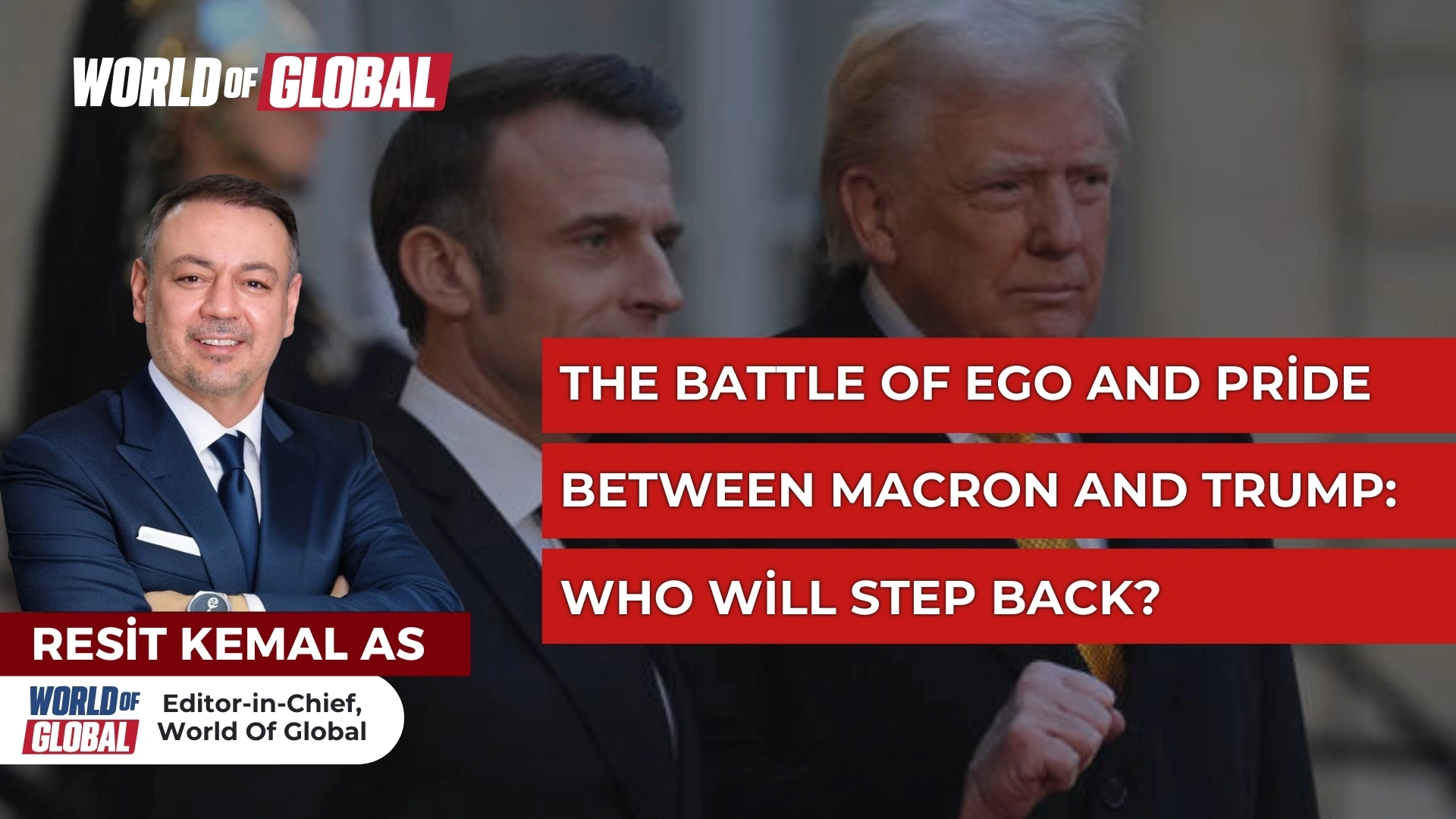
Resit Kemal As / Editor-in-Chief, World Of Global
International politics is often interpreted through the lens of interests; yet there are moments when the personal characters of leaders overshadow the official policies of states. The relationship between French President Emmanuel Macron and the old–new powerful figure of the United States, Donald Trump, reflects precisely such a struggle for power. This is no longer merely a diplomatic disagreement, but a psychological battle driven by ego, pride, and claims to leadership. The key question is: who will emerge victorious from this contest?
Macron seeks to position himself as the “strategic mind” of Europe. With a young, intellectual, and ambitious leadership profile, he may not be the first to question Europe’s security dependence on the United States, but he is certainly among the most vocal. His statement that “NATO is experiencing brain death” was not just a military assessment; it was a direct challenge to the Washington-centered world order. Against Trump’s brute-force style of diplomacy, Macron argues that Europe must build its own sense of pride and strategic autonomy.
Trump, on the other hand, views Macron less as an ally and more as a rival trying to steal the spotlight. In Trump’s political worldview, there is no diplomacy among equals—you either lead or you submit. Macron’s extended handshakes in front of cameras and symbolic gestures aimed at signaling an “equal partnership” are interpreted in Trump’s world either as weakness or as defiance. For this reason, Trump frequently targets Macron with dismissive rhetoric, because in this contest the ultimate weapon is psychological dominance.
At the center of this clash of egos lies the future of Europe. Macron envisions a Europe preparing for a post-Trump world: strategic autonomy in defense, independence in the economy, and multipolarity in diplomacy. Yet this vision faces a serious dilemma—Europe currently lacks the political unity and military capacity to sustain such an ambition. When Macron’s bold rhetoric fails to align with realities on the ground, it becomes easy fodder for Trump’s mockery.
Trump’s advantage lies in his ability to project power through simple and harsh language. The “pay up or lose protection” approach is crude but clear. Macron’s language, by contrast, is complex, intellectual, and rooted in long-term visions. This contrast makes Trump appear more “effective” and Macron more “idealistic” in the eyes of the global public. However, international politics often favors those who project decisiveness rather than idealism.
Still, it would be a mistake to view Macron as entirely weak in this rivalry. Every outburst by Trump deepens Europe’s strategic distrust of the United States, and Macron skillfully channels this distrust to reinforce his leadership narrative. Trump, perhaps unintentionally, strengthens Macron’s core argument: that the U.S. is an unreliable partner. This narrative may not dominate today, but it is likely to resonate more strongly in European politics tomorrow.
Ultimately, this is not simply a matter of winners and losers, but a matter of time. Trump may appear louder, more dominant, and more intimidating in the short term. Macron, meanwhile, is attempting to write a long-term story. Yet history teaches us that leadership contests built on ego and pride rarely produce true winners. More often than not, institutions, alliances, and stability are the real casualties.
So who will win? Perhaps Trump will claim another headline. Perhaps Macron will deliver yet another “visionary” speech at a summit. But the real test will be whether Europe can emerge from this battle of pride as an actor capable of standing on its own feet.