
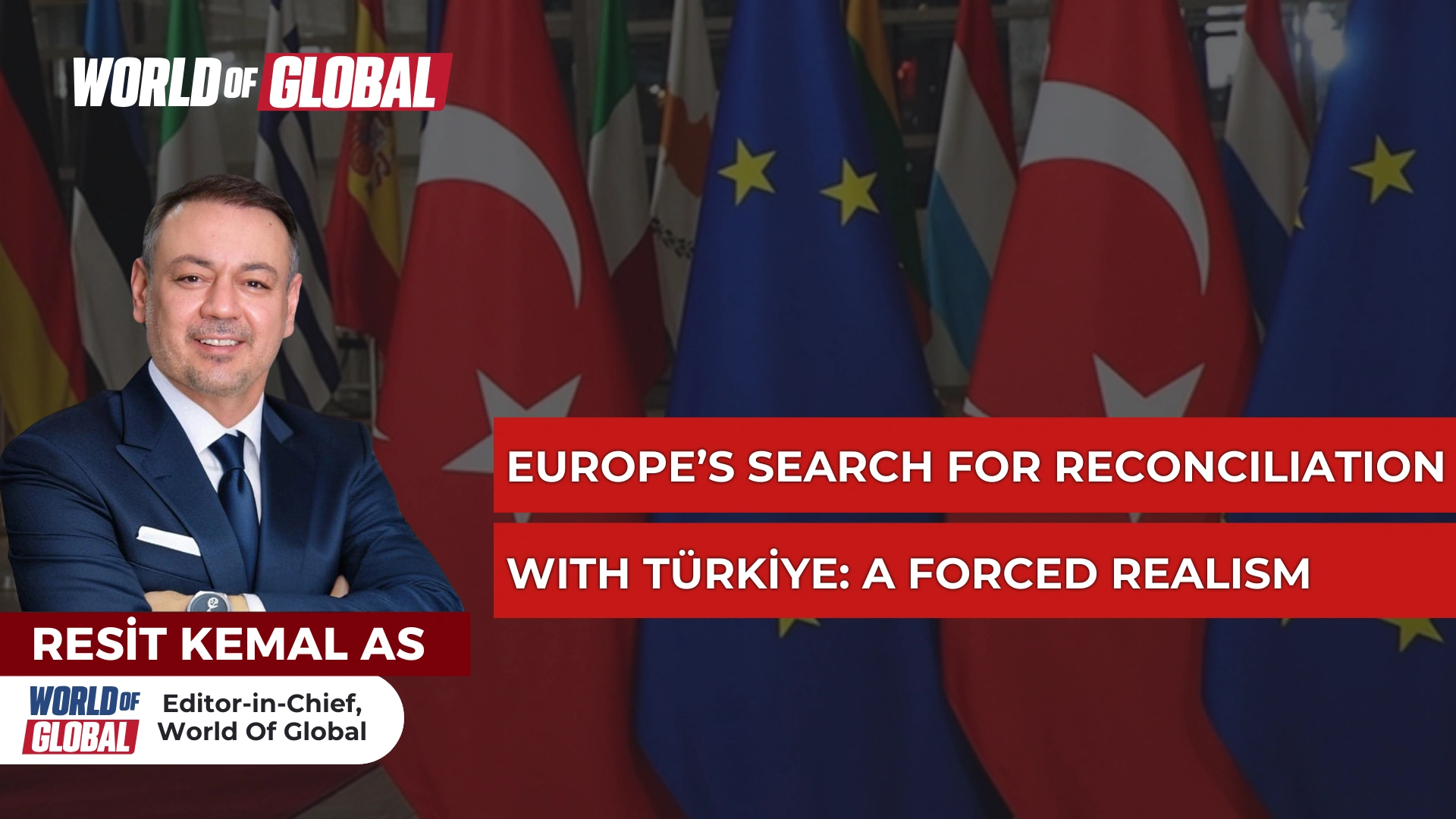
Resit Kemal As / Editor-in-Chief, World of Global
For many years, the European Union’s view of Türkiye resembled a chronic “problem file” rather than a strategic partnership. Criticism over democracy, the de facto freezing of accession negotiations, and the indefinite postponement of visa liberalization promises… All of these reflected the cold and distant approach that shaped Brussels’ relationship with Ankara. Yet today, the direction of the political winds in Europe is changing. Türkiye is no longer read as a problem in itself, but increasingly as an indispensable actor in solving problems.
Behind this shift lies not a romantic desire for “rediscovery,” but a hard geopolitical realism. In recent years, the European Union has been shaken by successive crises: the Russia–Ukraine war, energy security concerns, irregular migration, instability in the Middle East, and the United States’ increasingly distant stance on European security. This entire equation has reminded Europe of one basic fact: it cannot become a global actor without managing the world around it.
It is precisely at this point that Türkiye’s strategic weight has once again become visible. Active across a vast geography stretching from the Black Sea to the Middle East, and from the Caucasus to the Eastern Mediterranean, Türkiye is a country that cannot be ignored within Europe’s security architecture. Its NATO membership, key role in energy transit routes, and decisive position in migration management make Ankara a “difficult but necessary” counterpart for Brussels.
The change in the European Union’s perspective is, in fact, a kind of admission. It is increasingly recognized that excluding Türkiye does not solve problems, but rather deepens them. The migration crisis clearly demonstrated that no meaningful results can be achieved without cooperation with Türkiye. In terms of energy security, for a Europe seeking to reduce its dependence on Russia, Türkiye is not merely an alternative—it is almost a necessity. In the security domain, Europe’s limited military capacity makes closer cooperation with an effective, field-active actor like Türkiye unavoidable.
However, a critical question remains: Is this “revitalization” sincere, or merely circumstantial? Is the European Union continuing a reflex of remembering Türkiye only when it needs it, or does it genuinely intend to place relations on an equal and long-term foundation?
From Ankara’s perspective, the picture is not one-dimensional either. Türkiye views the normalization of relations with Europe not only as a diplomatic gain, but also as an economic and political balancing factor. Yet past experiences have taught Türkiye to be cautious. The memory of unfulfilled promises and negotiation chapters blocked for political reasons is still fresh.
Therefore, the coming period will be a test of sincerity for both sides. If the European Union truly regards Türkiye as a “solution partner,” it must demonstrate this not only in official reports, but through tangible steps. Visa liberalization, the modernization of the Customs Union, and the reopening of political dialogue channels would be the clearest indicators of such sincerity.
Ultimately, Europe’s changing approach toward Türkiye is not the result of choice, but of necessity. As the world moves away from its old, comfortable, and unipolar order, Europe is being forced to confront realities beyond its borders. Türkiye, meanwhile, is once again reminding the world that it is not a candidate country waiting on the sidelines, but an actor with a voice at the table. The real question is whether this awareness will prove lasting.
Because in international relations, the true test does not come during times of crisis, but in the promises kept after the crises have passed.