
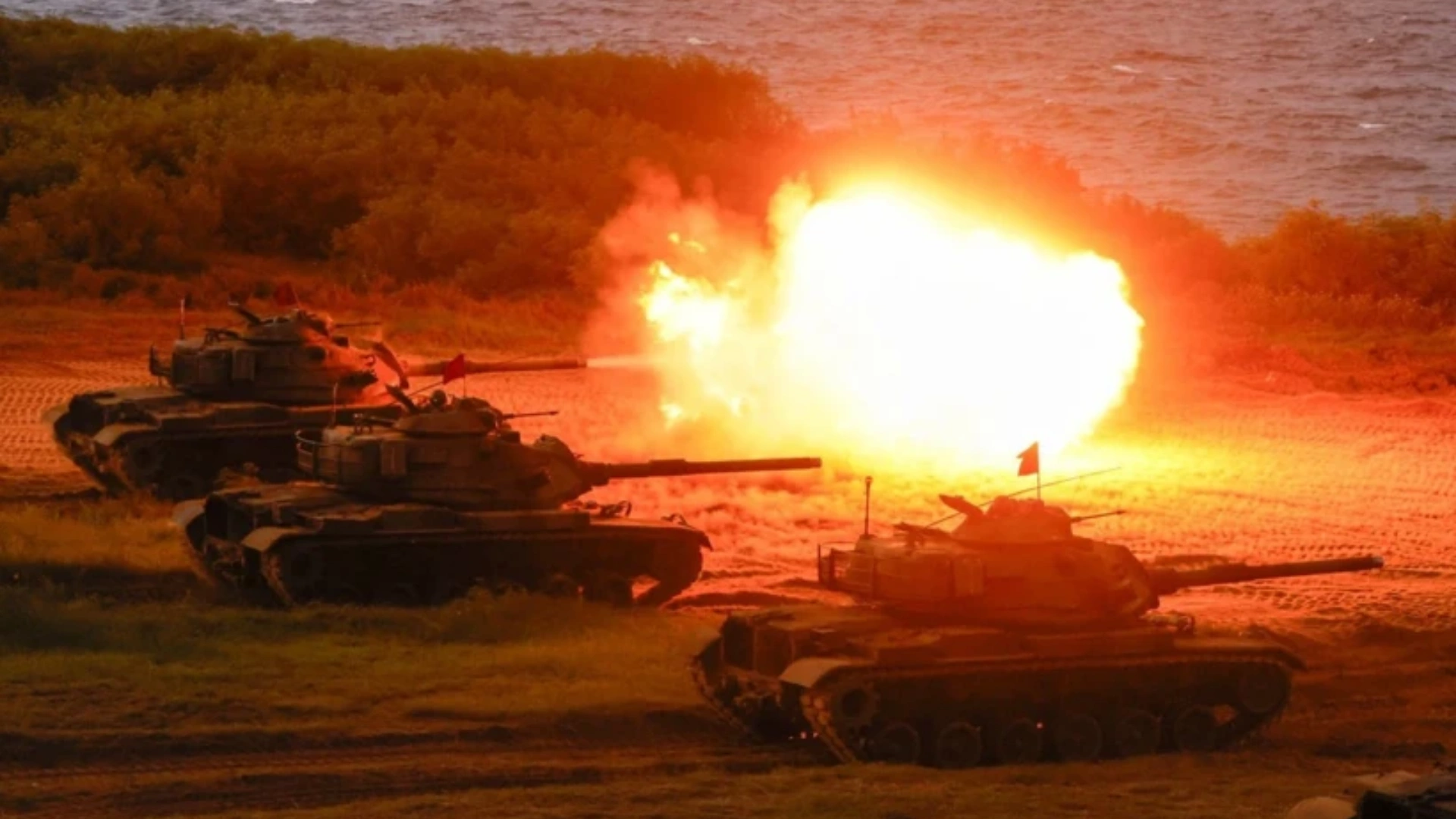
Taiwan is conducting one of its most comprehensive defense exercises to date amid rising tensions with China and the possibility of a potential attack. As part of the annual Han Kuang military exercises, air and amphibious assault scenarios using live ammunition are being tested on the Penghu Islands, while the resilience of communications infrastructure in a potential war will also be assessed. As part of the exercise, mobile internet speeds will be deliberately reduced for the first time.
Taiwan has expanded its military drills to include civilian infrastructure as it steps up preparations against the perceived threat from China across the Taiwan Strait. More than 20,000 reservists are taking part in the 10-day exercise, which began on August 5.
Live-Fire Defense Drill on the Penghu Islands
The Penghu Islands, which hold strategic importance due to their proximity to the Chinese coast, have become one of the key locations of the exercise. Before dawn, Taiwanese forces deployed along the coastline conducted defensive scenarios against potential air and amphibious assaults using M60A3 tanks, artillery systems and anti-aircraft weapons.
The exercise is testing a “multi-layered” defense model designed to stop a potential enemy advance through multiple defensive lines.
For Taiwan, losing control of the Penghu Islands could give the Chinese military a strategic forward base for missile and unmanned aerial vehicle attacks against Taiwan’s main island. For this reason, the defense of the islands is considered critical in Taiwan’s military planning.
Mobile Internet to Be Throttled in a War Scenario
One of the most notable elements of the Han Kuang exercise is the digital warfare scenario. Taiwan will test the resilience of its mobile communications infrastructure against the possibility of base stations being damaged or communication networks becoming overloaded during a potential conflict.
As part of the test, mobile internet speeds will be deliberately reduced for 30 minutes. The first test is being conducted in central Taiwan, while a second test is scheduled for August 13 in northern areas, including the capital Taipei.
During the restriction, bandwidth-intensive activities such as video calls and file transfers are expected to become more difficult. However, voice calls, text messages, ATM systems and emergency hotlines are expected to remain operational.
More Than 20,000 Reservists Taking Part
More than 20,000 reservists are actively participating in the 10-day exercise. The scenarios extend beyond battlefield combat conditions.
The Taiwanese military is also testing scenarios involving the dispersal of fighter jets to alternative runways, the protection of critical bridges and the use of civilian factories to support military production during wartime.
The exercise is also introducing, for the first time, a command-and-control model used by the U.S. military. Under the system, lower-ranking personnel confirm orders from their superiors in their own words in an effort to prevent misunderstandings.
Taiwan Crisis Poses Risk to Global Chip Supply
Rising military tensions around Taiwan pose not only a regional security challenge but also a significant risk to the global economy.
The presence of TSMC, the world’s largest contract chipmaker, in Taiwan has raised concerns that a potential war or prolonged blockade could cause a major disruption to global technology supply chains.
Any disruption in the supply of advanced chips used in everything from artificial intelligence processors to smartphones could directly affect the global technology industry. A prolonged blockade or conflict in the Taiwan Strait could lead to serious disruptions in the global supply of semiconductors.