
Resit Kemal As / Editor-in-Chief, World of Global
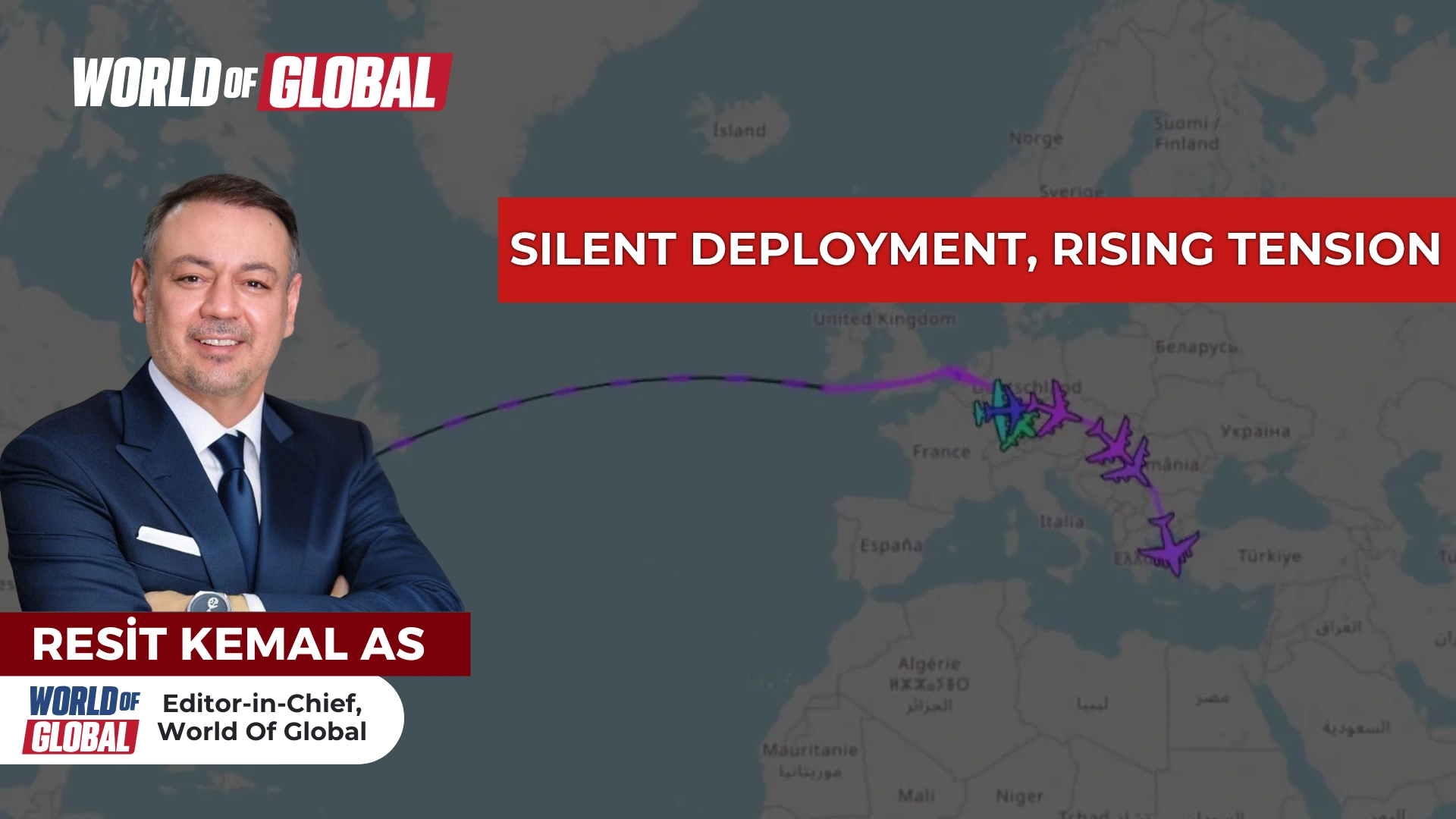
The United States has conducted 193 transport flights to the Middle East and deployed at least 46 aerial refueling aircraft across Europe and various parts of the region. This falls into that second category of developments — the kind that may not dominate headlines but quietly reshape the strategic landscape.
This is not an exercise.
This is not a routine rotation.
This is a calculated construction of military architecture.
Logistics Speak, Diplomacy Falls Silent
In international crises, leaders may use soft language.
“We support diplomacy,” “We seek de-escalation,” “We stand for peace” — such phrases are frequently heard.
But military logistics speak a different language.
One hundred ninety-three transport flights mean the flow of munitions and personnel.
Forty-six refueling aircraft mean long-range and sustainable air operation capacity.
Without aerial tankers, modern combat aircraft cannot remain airborne for extended periods.
As that number rises, operational depth increases.
This picture tells us one thing:
The United States is not narrowing its options. It is expanding them.
The Iran File Heats Up Again
U.S. Senator Lindsey Graham’s remark — “The ships are not going there because the weather is nice this time of year” — is not diplomatic rhetoric. It is a strategic warning.
Washington’s patience toward Iran appears to be thinning.
Yet this impatience does not necessarily point to a regime-change agenda.
A more plausible scenario may include:
- Weakening missile infrastructure
- Pressuring proxy militia networks
- Rolling back nuclear capacity
- Hardening deterrence
In other words, not a full-scale war, but a controlled and forceful capacity-reduction strategy.
Why Is Europe Involved?
The deployment of refueling aircraft to Europe is a critical detail.
It suggests that any potential operation would not be limited to the Gulf.
The Mediterranean corridor, NATO infrastructure, and European bases are part of the equation.
This is also a message to Iran:
“The operational theater is not narrow.”
The United States is not opening a new front.
It is widening the operational space.
The Psychological Threshold
Military buildups are not always meant to start wars.
Sometimes they are meant to amplify the possibility of war.
This move sends a message to three audiences:
- The Iranian leadership
- Regional allies
- The American domestic audience
Washington may be signaling:
“If you refuse the table, we are prepared to overturn it.”
This is as much a psychological pressure operation as it is a military maneuver.
The Global Calculation
Interpreting this move solely through the Iran lens would be incomplete.
It also sends:
- An indirect message to China
- A balancing reminder to Russia
- Reassurance to Gulf states
- A signal of support to Israel
The Middle East is no longer merely a regional crisis zone; it is an intermediate arena of global power competition.
The Critical Point for Türkiye
For Türkiye, such tensions are not merely foreign policy headlines.
Energy prices, the security balance in Iraq and Syria, Gulf trade routes, and diplomatic maneuvering space would all be directly affected.
What Türkiye must do is clear:
- Preserve its balance policy
- Avoid becoming part of escalation
- Position itself as an actor that manages, not amplifies, crises
In such moments, composure becomes strategic strength.
Has the Trigger Been Pulled?
Not yet.
But the safety is no longer fully on.
What Washington is doing is not simple:
It is building the infrastructure required to act the moment a decision is made.
This could be the prelude to a sudden strike.
Or the peak of coercive diplomacy.
What is certain, however, is this:
Washington has reopened the Middle East file.
And this time, it is not at the table to close it — but to reshape it.
The coming weeks will be decisive.
Because sometimes war does not begin when the first bomb falls,
but when the first refueling aircraft takes off.