
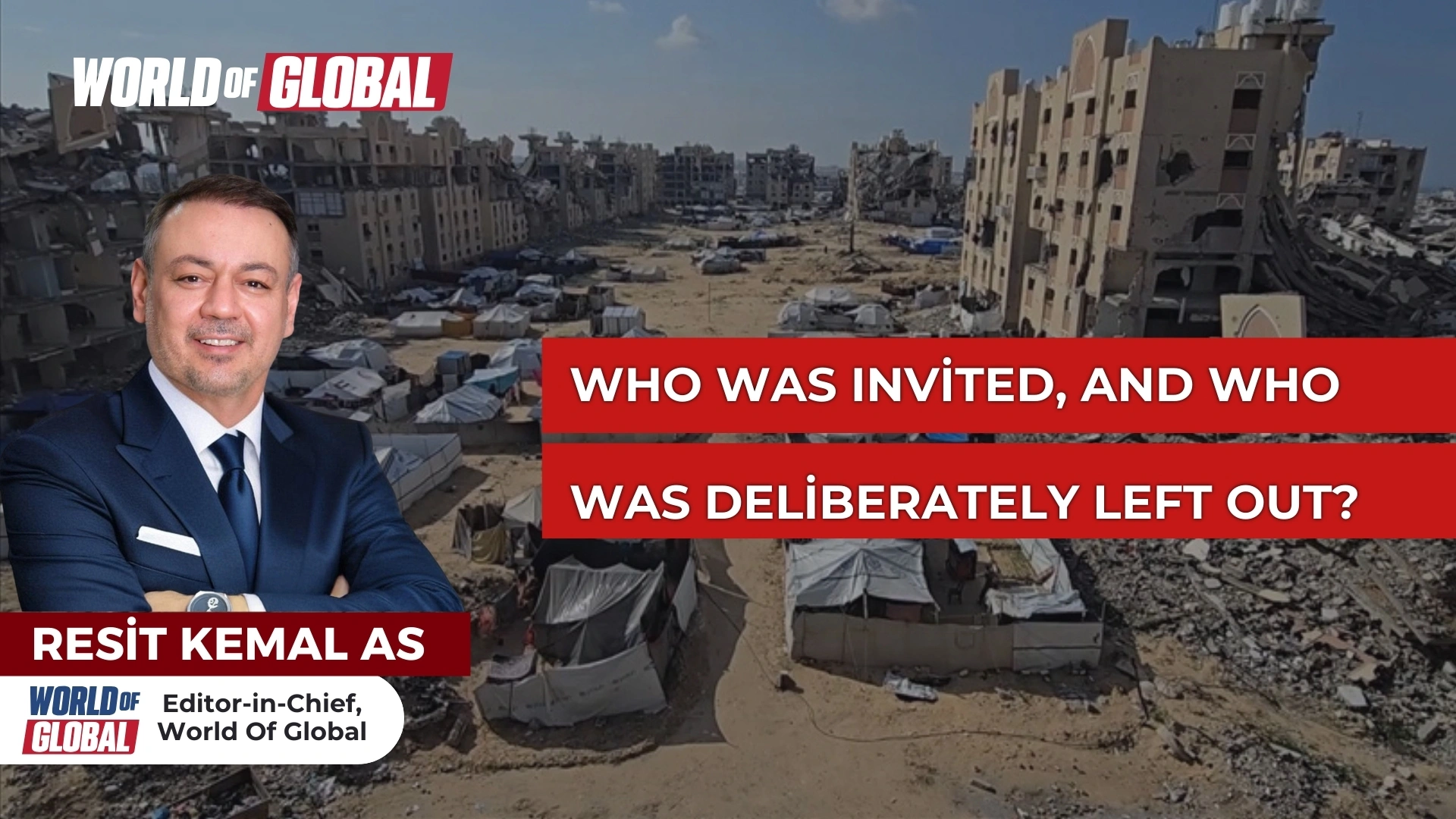
Resit Kemal As, Editor-in-Chief, World Of Global
When the phrase “peacekeeping force” is first mentioned for Gaza, it sounds appealing. After all, who could be against peace? But when the issue is Gaza—and especially when the architect of the idea is the United States—one cannot help but feel uneasy. History has taught us this much: when the U.S. speaks of peace in the Middle East, it often means a carefully managed silence—control rather than justice.
The so-called “international peacekeeping force” now being proposed by Washington claims to fill the security vacuum that emerged after Gaza’s devastation. The official narrative is clear: civilians will be protected, humanitarian aid will be secured, and radical groups will be prevented from regaining strength. But what lies behind the curtain?
Who Was Invited, and Who Was Deliberately Left Out?
The U.S. invitation list is far from accidental. Certain European countries, “non-problematic” actors from the Arab world, and states capable of providing financial contributions are brought to the forefront. What do these invitees have in common?
They lack the power to determine Gaza’s political future, yet they are visible enough to lend legitimacy to decisions already made.
Countries like Türkiye, Egypt, and Jordan—those who know the region best—are kept in conditional or cautious positions, while Gulf states are expected to join primarily as financial backers. Europe, as usual, finds itself trapped between conscience and Atlantic loyalty.
The most striking absence, however, is impossible to ignore:
The Palestinians.
Plans are being discussed to govern, protect, and rebuild Gaza—yet the political will of the people of Gaza is nowhere at the table. This is not peace; it is an attempt to monopolize the very definition of peace.
What Does the U.S. Really Want?
Answering this question solely with “Israel’s security” is no longer sufficient—though it remains valid. An international force in Gaza would ease Israel’s military burden while transferring security responsibility to an “internationalized” structure. Israel would become less visible on the ground, but control would remain intact.
Another major gain for Washington is image. The role of “leader of the world order,” worn down in Ukraine, China, and across the Global South, is now being rehabilitated through Gaza. Presenting itself as the force that delivers peace is not merely a moral aspiration—it is a strategic necessity.
And, of course, the most critical objective of all:
Detaching Gaza’s future from the Palestinian resistance tradition.
Under the banner of dismantling armed groups, Gaza’s political memory itself is being redesigned. For this reason, the peacekeeping force is not merely a military tool—it is a project of political engineering.
Peacekeeping Force or Trusteeship Force?
Here lies a painful contradiction. If peace is truly desired in Gaza, why is it not built upon Palestinian consent? Why are the plans written in Washington rather than shaped by those who live on the ground?
For the people of Gaza, the word “security” has long lost its meaning under the shadow of tanks and drones. What they need is not silence within boundaries drawn by others, but genuine ownership over their own destiny.
If today’s so-called “peace force” turns into a structure that governs, supervises, and restricts Gaza tomorrow—who would really be surprised?
There are few reasons to believe that America seeks to bring peace to Gaza; but there is more than enough history to justify caution. Peace is not built by armed contingents, but by justice, legitimacy, and the will of the people.
Otherwise, what arrives in Gaza will not be peace.
It will merely be a more orderly, quieter, and longer-lasting form of oppression.