
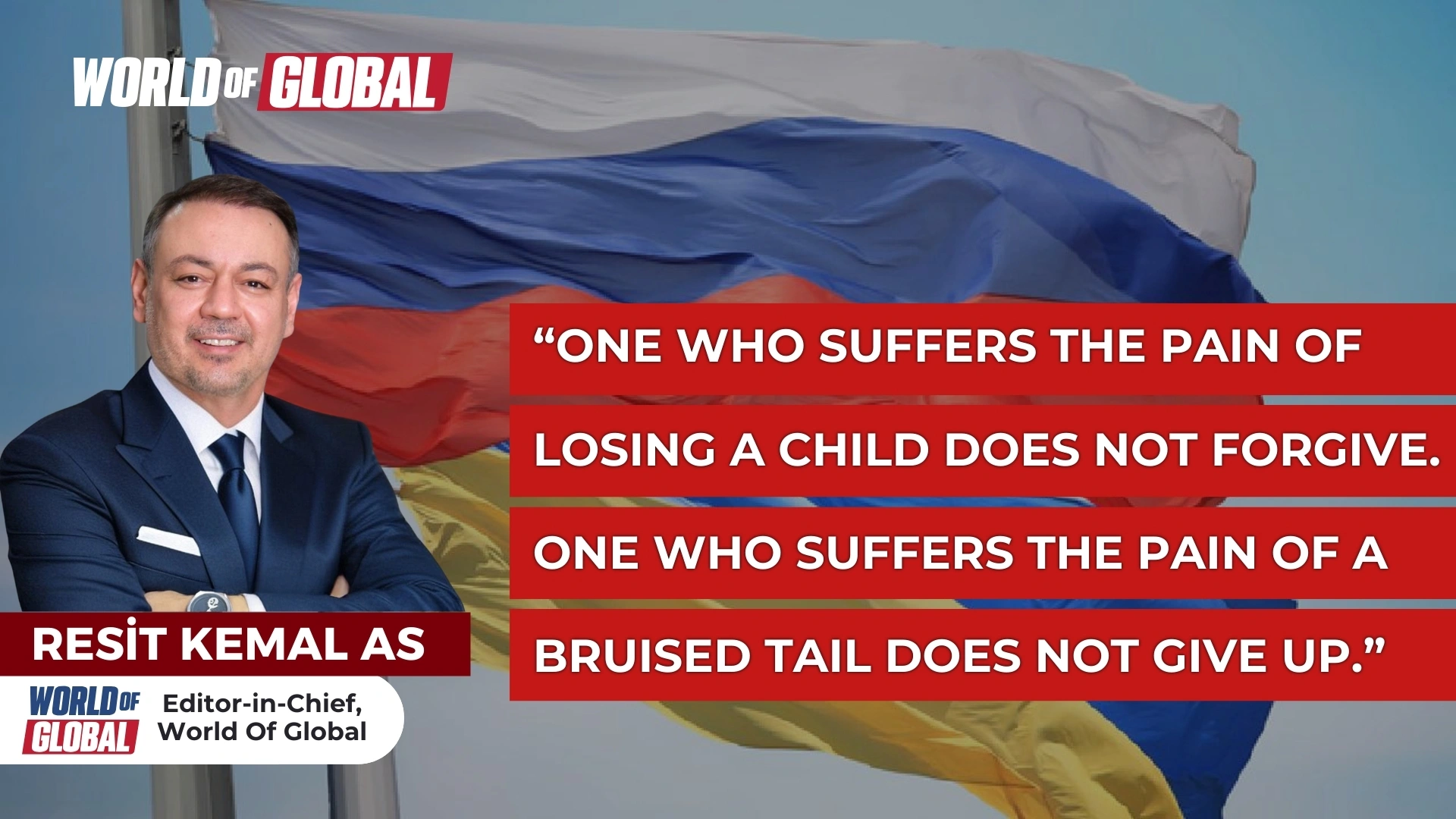
Resit Kemal AS – Editor-in-Chief, World of Global
Years ago, I said:
“When I carry the pain of losing a child, and you carry the pain of a bruised tail, we cannot be friends.”
When I used this sentence to describe the Ukraine–Russia war, I was, in fact, summarizing in a single line why this war refuses to end.
Because this war is not merely a conflict of tanks, missiles, or front lines.
It is a war between existence and revenge, between survival and the reflex of a lost empire.
And these two emotions cannot sign peace at the same table.
Today, we look at the world:
The United States, Europe, China, Turkey…
Everyone speaks of “peace.”
Everyone calls for a “ceasefire.”
Everyone claims to be “working toward a solution.”
Yet the war continues.
Because peace is not just a diplomatic document.
Peace means that the parties can speak their pain in the same language.
Ukraine and Russia do not speak the same language—
they cannot even utter the same word with the same pain.
📌 Ukraine’s Pain: The Pain of Losing a Child
For Ukraine, this war is not a geopolitical calculation.
It is the war of a mother who has lost her land,
a father who has buried his son,
a child who has lost his home.
When Ukraine speaks of “territory,”
it does not mean a piece of land on a map as Russia sees it;
it means its cemeteries, its cities, its childhood.
Ukraine’s pain is the loss of life.
Ukraine’s pain is the fear of extinction.
Ukraine’s pain is the question: “Will we ever exist again?”
That is why Ukraine’s call for peace
does not mean “let us give up a little more land.”
That is why, for Ukraine, peace risks becoming
an irreversible surrender.
The pain of losing a child does not accept bargaining.
📌 Russia’s Pain: The Pain of a Bruised Tail
Russia, on the other hand, carries a different kind of pain.
This is the pain of lost power, diminished influence, a faded empire.
When Russia launched this war,
it did not target Ukraine alone;
it challenged the post–Cold War world order.
For Russia, the core issues are:
– NATO’s expansion
– Western encirclement
– The fragmentation of the former Soviet sphere
In other words, Russia’s concern is not children—it is prestige.
Russia’s pain is not land—it is control.
That is why Russia must “win.”
Powers suffering from a bruised tail know that if they step back,
they may never stand upright again.
That is why peace for Russia is impossible
unless an “honorable exit” is secured.
📌 Does the World Want Peace, or Just the Image of It?
This is where the real question begins.
Does the world truly want this war to end,
or does it prefer it to continue—carefully managed?
– The arms industry is thriving
– Energy markets are being reshaped
– Global blocs are becoming clearer
– A new world order is slowly taking form
For some, this war is a tragedy.
For others, it is a strategic opportunity.
Calls for peace are often not sincere;
they are simply a polite way of asking,
“How much longer can you endure?”
The world does not want the war to end.
It wants the war not to spiral out of control.
📌 Why Will This War Not End?
Because on one side stand those who have buried their children,
and on the other stands a power whose tail has been stepped on.
Those who suffer the pain of losing a child do not forgive.
Those who suffer the pain of wounded pride do not give up.
That is why this war will not end with a treaty,
but only when one side is emotionally exhausted.
Peace does not arrive when it is spoken of the most,
but when exhaustion reaches its peak.
Until that day comes,
the world will continue to perform the theater of peace,
Ukraine will continue to bleed,
and Russia will continue to harden—refusing to retreat.
Because some wars are not fought on maps,
but on honor and pain.
And there, words fall silent.