
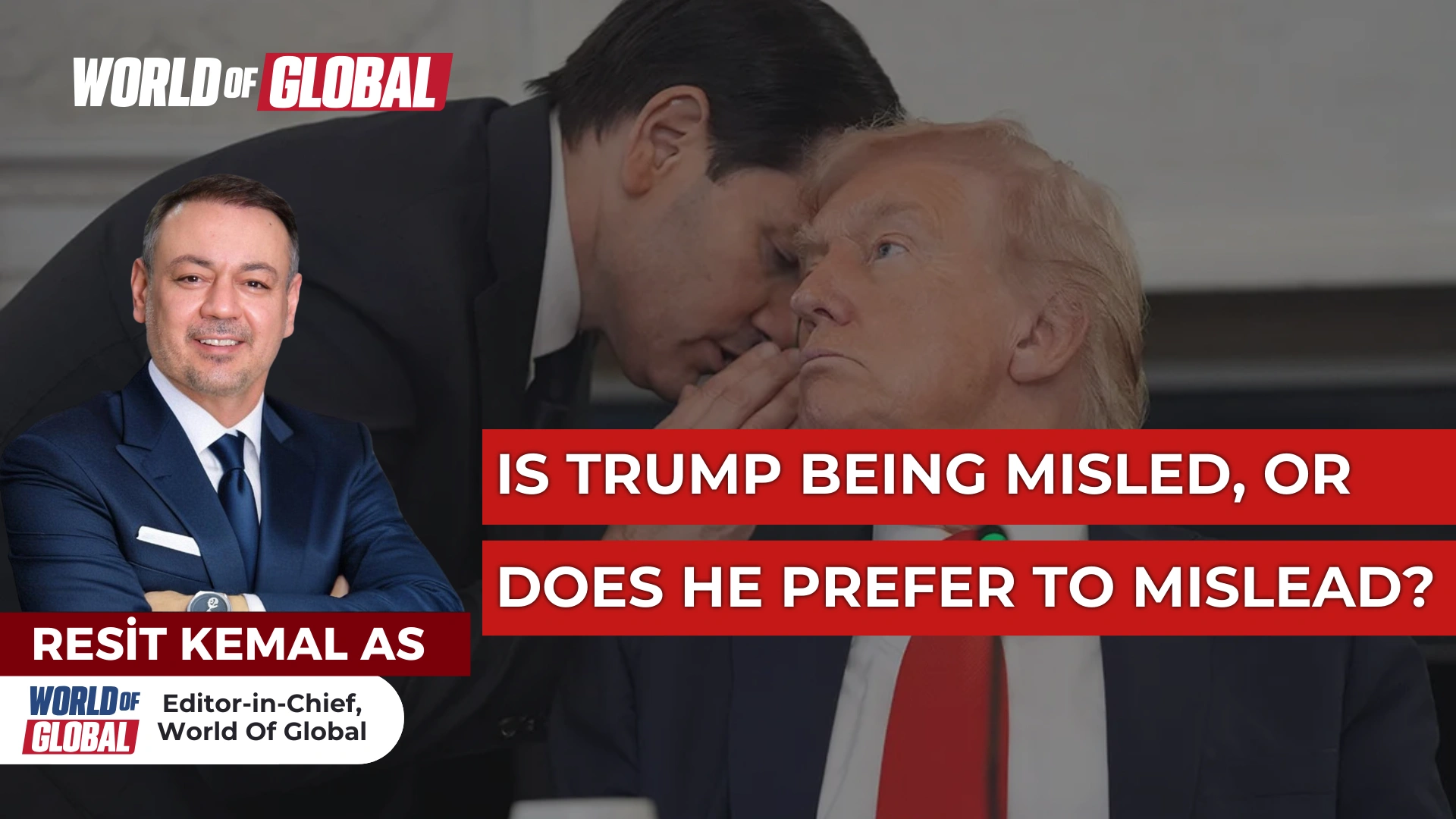
Resit Kemal As / Editor-in-Chief, World of Global
In U.S. foreign policy, sometimes the biggest crises do not erupt on the ground, but in sentences. Donald Trump’s recent claim that “high-level talks with Havana are ongoing” points to exactly such a fracture. Because there are no talks. At least, that is what the Cuban side and independent diplomatic channels say. So the question is simple yet deeply unsettling: Is Trump being misled, or does he choose to mislead?
The shadow of this question falls directly on Secretary of State Marco Rubio. We are talking about a Cuban-American politician, a hardline advocate of sanctions, and an ideologically distant figure when it comes to Havana. Rubio’s political career has been built on presenting pressure against the Cuban regime as a moral imperative. For such a figure to give the White House the impression that “back-channel diplomacy” is underway inevitably raises the possibility of strategic distortion.
As U.S. fuel and financial sanctions push Cuba toward a severe energy crisis, Washington’s message that “negotiations are ongoing” serves two purposes:
First, it presents the United States to the international public as the party “seeking solutions.”
Second, it renders the humanitarian consequences of the sanctions invisible.
But Havana is not silent; it says, “There are no talks.” This contradiction suggests that what is speaking here is not diplomacy, but perception management.
Reading this picture solely as a Cuba issue would be naïve. The same fog appears in the Russia–Ukraine war, the Iran file, and even in the strategic competition with China. On the one hand, the U.S. administration says “contacts are continuing behind the scenes”; on the other, tensions on the ground keep escalating. If negotiations truly exist, why are the crises deepening? And if they do not, whom does this rhetoric serve?
Trump’s personal diplomatic style plays a key role here. He is often more concerned with the sense of control than with the process itself. Saying “there are talks” means saying “I am in control.” But when this narrative does not align with institutional reality, it weakens not the president, but the state. Because foreign policy is not limited to a television interview aimed at domestic audiences; the other side speaks too—and it takes note of falsehoods.
In the case of Marco Rubio, the real issue is whether information is being withheld or repackaged. When Trump is told that “talks are ongoing,” what may be meant are merely indirect contacts or exploratory feelers through third countries. But presenting this as “high-level negotiations” is not bending reality—it is rewriting it.
Today, the real crisis Washington faces is not Cuba’s energy shortage or the opening of a new line of tension with Iran. The real crisis is the widening gap between rhetoric and reality. Diplomacy requires trust, and trust begins with accurate information. If a president is making decisions based on a foggy picture drawn by his own foreign policy team, this becomes not just a governance problem, but a global risk.
So we return to the core question:
Is the United States truly negotiating, or merely talking as if it is?
The answer is unclear. But one thing about uncertainty is clear—it is dangerous:
A superpower that loses contact with reality does not only mislead its rivals; it misleads itself.