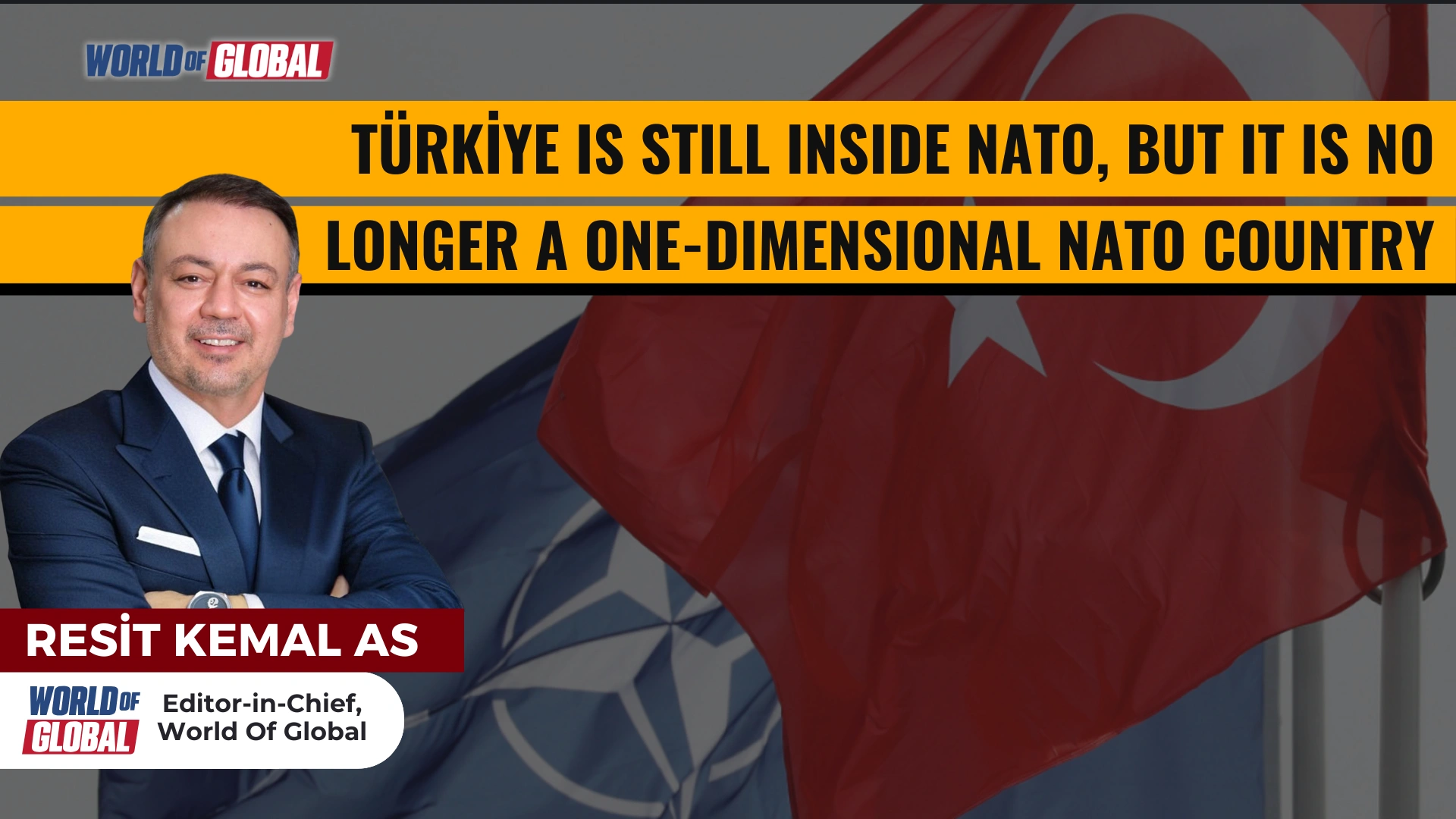
Resit Kemal As / Editor-in-Chief, World of Global
War in the Middle East, tensions in the Black Sea, energy competition in the Eastern Mediterranean…
Whenever a crisis erupts in our region, the same debate reignites in Türkiye:
“Should Türkiye leave NATO?”
“Atlantic or Eurasia?”
This question has almost become a reflex. Yet the debate itself is often built on the wrong foundation. Because Türkiye’s geopolitics is not based on choosing between two poles.
Türkiye’s geopolitics is based on building balance.
And this distinction is often overlooked.
Türkiye Is Not a Country That Fits Into a Single Axis
Türkiye is not an ordinary regional country.
Its geography makes it not only a natural transit state but also a center of balance.
On one side lies Europe and the Atlantic system,
on the other side Russia, China, and the geopolitics of Eurasia.
We are neighbors with Russia in the Black Sea.
We possess the second-largest army in NATO.
Our economic ties with Europe are deep.
Our strategic relations with the Turkic world are expanding.
To tell such a country “either this or that” is geopolitical ignorance.
Türkiye is neither solely Atlantic nor solely Eurasian.
Türkiye is a country that must build its own axis.
NATO: A Security Umbrella or a Strategic Instrument?
When Türkiye joined NATO in 1952, the world was bipolar.
The Soviet threat was clear and the security architecture was straightforward.
Today, however, the world is moving toward a multipolar structure.
For this reason, NATO membership for Türkiye is no longer just a military alliance. It is also a strategic instrument.
NATO provides Türkiye with three fundamental advantages:
First, deterrence.
Second, military technology and integration.
Third, a voice within the global security architecture.
However, these advantages do not eliminate Türkiye’s right to make independent strategic decisions.
Recent crises clearly demonstrate this reality.
The S-400 crisis,
the Syria policy,
the Eastern Mediterranean tensions…
In all these issues, Türkiye acted by prioritizing its own national security interests.
This actually reveals a new strategic reality:
Türkiye is still inside NATO, but it is no longer a one-dimensional NATO country.
Is the Eurasian Option Realistic?
Whenever NATO debates intensify, a familiar question emerges:
“Should Türkiye turn toward Eurasia?”
The answer to this question is often based on ideological romanticism.
The Eurasian space itself contains serious internal rivalries.
There are strategic tensions between Russia and China.
A clear regional security architecture has not yet fully formed.
In short, Eurasia today is not a military alliance but rather a geopolitical space.
For Türkiye, relations with Eurasia are of course important.
Strong cooperation should be developed in energy, trade, transportation, and security.
However, this does not require breaking away from the Atlantic system.
On the contrary, this is precisely where Türkiye’s strength emerges:
Being one of the rare countries capable of speaking with both systems.
The New World Order and Türkiye’s Role
The world can no longer be explained through the old alliance frameworks.
The Russia–Ukraine war,
new tensions in the Middle East,
the U.S.–China rivalry…
All these developments show us one thing:
In the future world, the strongest countries will not be those trapped within a single bloc, but those capable of acting in multiple directions.
Türkiye is precisely such a country.
A country that can maintain dialogue with Russia in the Black Sea,
provide military strength within NATO,
conduct diplomacy in the Middle East,
and build strategic integration with the Turkic world.
This capacity carries Türkiye beyond the limits of traditional alliance structures.
The Real Debate Is Not NATO, But Strategic Confidence
In Türkiye, NATO debates often turn into an identity debate.
Two sharp camps emerge: Atlanticists and Eurasianists.
Yet the real strategic question is this:
How much confidence does Türkiye have in its own power?
Strong countries do not avoid alliances.
But neither do they become dependent on them.
What Türkiye needs is not to choose a new axis, but to strengthen its own.
Türkiye’s Path Is the Third Way
Türkiye can neither become the forward outpost of the Atlantic nor the periphery of Eurasia.
The destiny of this country is not to choose a bloc, but to build balance between blocs.
Because Türkiye’s real strength lies not in being part of an alliance,
but in alliances needing Türkiye.
And in geopolitics, that is the strongest position of all.