
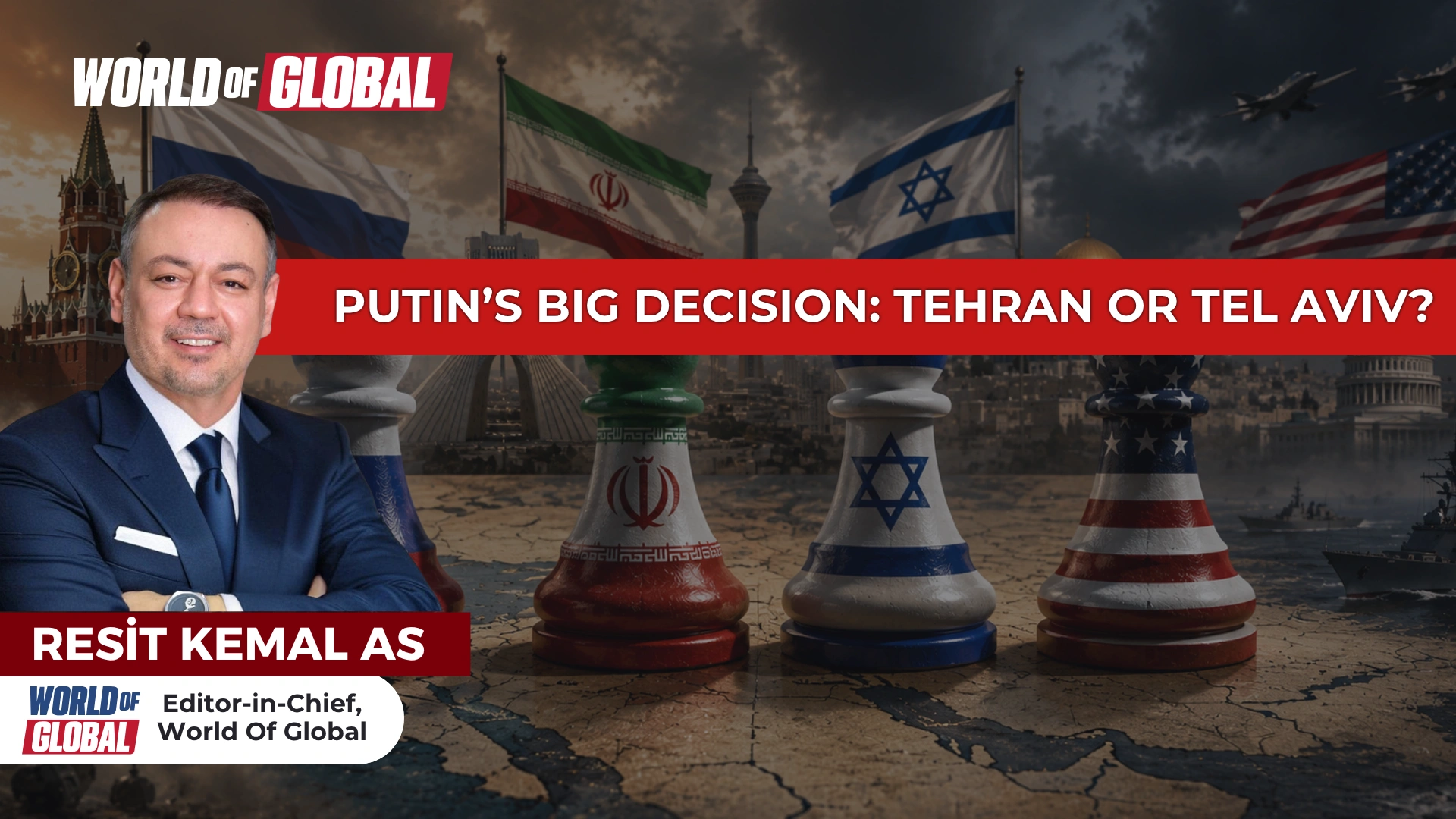
Resit Kemal As / Editor-in-Chief, World of Global
The Russia–Ukraine war is no longer just a war; it has turned into a war of attrition.
During World War I, millions of people lost their lives and entire cities were destroyed. Of course, in terms of casualties, the current conflict cannot be compared to that catastrophe. However, when we look at its duration, the Russia–Ukraine war has already become one of the longest and most costly conflicts in modern history.
From Moscow’s perspective, Russia is not facing Ukraine alone.
The United States is involved.
NATO is involved.
The European Union is involved.
Western media is involved.
Economic sanctions are involved.
The global financial system is involved.
In other words, Russia sees itself as confronting not a single country, but an organized coalition of states.
The prolonged nature of the war is precisely why different calculations are now being made in Moscow.
One of the questions that may be asked inside the Kremlin today is:
“Could a move be made that would damage the Middle Eastern interests of the countries helping to prolong this war?”
This is where the Iran file comes into play.
Although Russia and Iran have appeared to stand on the same side for years, their relationship has never been a genuine alliance. They have moved closer only as much as their mutual needs required.
Russia’s priority has always been its own national interests.
Iran’s priority has always been the survival of its regime.
For that reason, Moscow could establish new partnerships tomorrow if circumstances change.
But what would happen if Russia were to pursue closer cooperation with Israel?
First of all, the balance of power in the Middle East would change dramatically.
Iran would likely feel increasingly isolated.
The dynamics in Syria could be reshaped.
The Gulf states might begin to view Moscow more favorably.
Meanwhile, the Western camp could be caught by surprise.
For years, many analysts and policymakers have become accustomed to viewing Russia through the lens of its relationship with Iran. A new geopolitical reality would be difficult for many of them to interpret.
However, one important fact should not be forgotten.
Improving relations with Israel would not automatically remove Western pressure on Russia.
For Moscow, the Ukraine issue is no longer merely a territorial dispute; it has become a matter of national security and regime survival.
Therefore, the Kremlin’s core objectives are unlikely to change.
Yet as the war drags on, it becomes increasingly inevitable that Russia will begin playing new cards.
Perhaps the biggest surprise in the coming period will not emerge on the battlefield, but at the diplomatic table.
Sometimes wars are won not with tanks, but by changing friends.
History has shown repeatedly that states do not have permanent friends.
They have permanent interests.